The headlines today are filled with the war with Iran: bombs, threats, politicians talking tough while the rest of us watch and hope someone in charge remembers how quickly stupidity and pride can turn a crisis into catastrophe. It feels reckless, familiar, and dangerous in the way wars often do just before they spiral.
But the story I’m thinking about begins in the summer of 1979.
So let’s be cliché—North to Alaska.
Play Ball
In 1979, I had the privilege of attending the famous Midnight Sun Baseball Game in Fairbanks, Alaska. The Alaska Goldpanners defeated the University of North Carolina Tar Heels, 8–2 — the game was played on the summer solstice without artificial lights and started at 10:30 p.m.
I was there, and other than marveling at the lack of lights, the buzz of the crowd, and the temperature feeling warmer than the high-50s it actually was, I remember almost nothing about the game itself. But damn—baseball at midnight with no lights? It was like dusk. Barely. And then, slowly, it started getting lighter. The North Carolina players didn’t look overmatched exactly, but they played like they were. Maybe it was the setting. The time of night. The endless twilight. Maybe just being in Alaska.
Whatever the reason, the whole thing felt surreal.
Alaska Time
In the spring of 1977 my dad decided to move to Fairbanks, Alaska. I was finishing my freshman year at the University of Kansas when he accepted the superintendent position for the Fairbanks school district.
I went up that summer, but it wasn’t much of an adventure. Mostly I worked on a yard crew and saved money for the upcoming school year.
The Stallard Blurb is reader-supported. To receive new posts and support my work, consider becoming a free or paid subscriber.
My real Alaska experience came two years later — the summer of ’79.
That summer a lot of things converged on me — my dreams, my shaky confidence, what I thought I could become, and how easily success and failure could sit right next to each other.
At the time, of course, I didn’t have a clue about any of that.
The Summer I Didn’t Want
The truth is, I didn’t want to go back to Fairbanks. But I was talked into. Dad pulled a few strings and got me a decent summer job at the university, and the paycheck was nice enough. But the real surprise of that summer turned out to be the classes I took at the University of Alaska.
One education class I had was a blast—I don’t remember the name, but we had a visiting prof and he was fun. Another class was fine, I remember nothing about it.
The best part of the summer, though, was something I never expected.
The Midnight Sun Writers Conference.
Writers, students, other participants came from everywhere—New York, California, the South, the Southwest, the Midwest. There were established poets, a well-known novelist from New York, award-winning authors and plenty of hopeful writers who wanted to see if what they had to say was worth saying.
And then there were people like me; college students who had sort of stumbled into the whole thing. I just knew I wanted to be a writer. And at that point in my life, I had absolutely no concept as to what that actually meant.
Living Alaska
That summer felt strange in a hundred little ways.
My job at the university was as an office assistant—I did grunt work around the university, office cleanup, ran errands and other stuff. It was fun and the people I worked for were great.
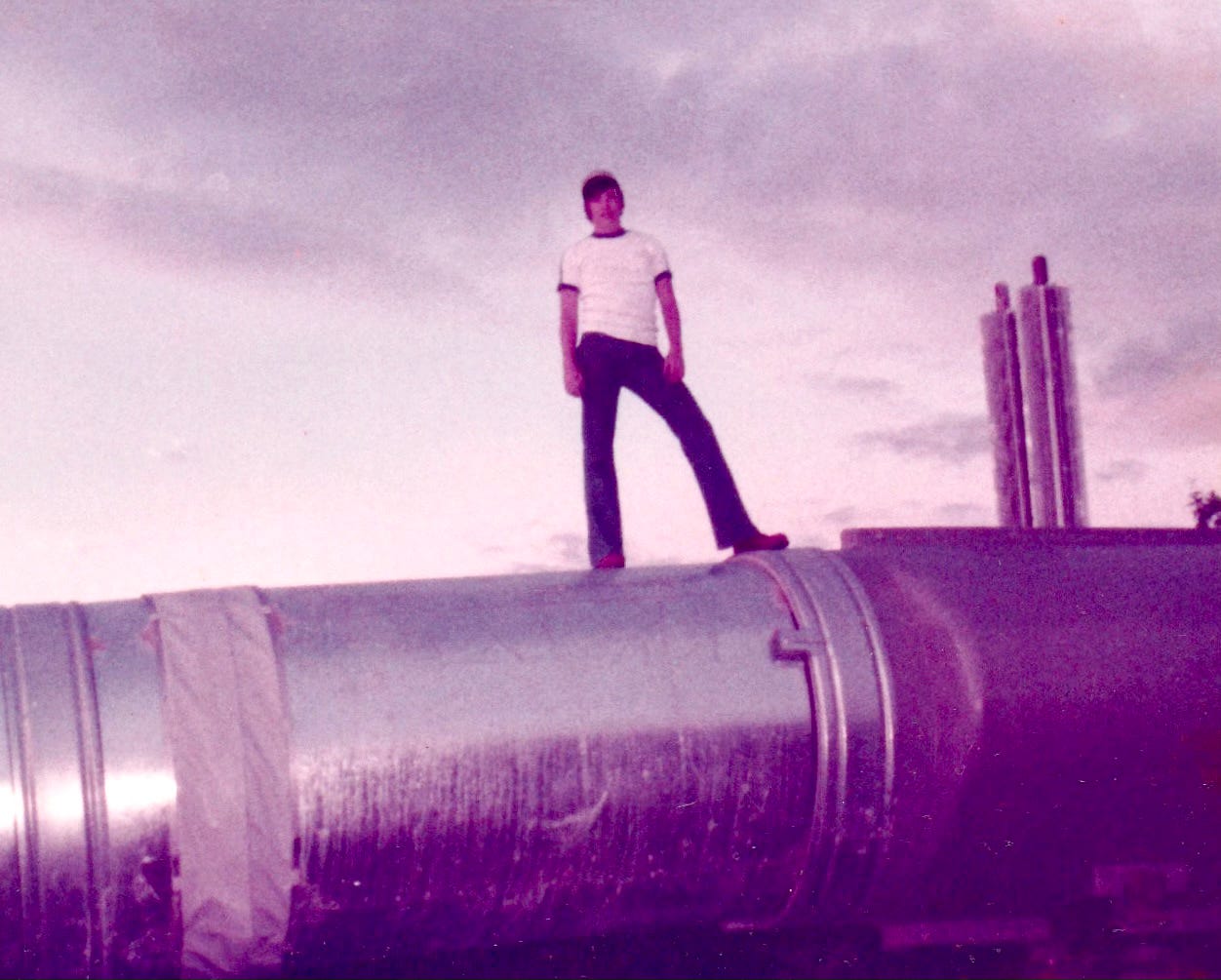
Yeah, I got picture of myself standing on the Trans-Alaska Pipeline. This was taken around 11:00 pm.
I took in a few things around the area. I saw the Trans-Alaska Pipeline System, got to fly a short flight in a tiny two-man plane that looked like it belonged in a different century, stayed out way late almost every night I was there—I was eating at three in the morning half the time because daylight never seemed to end.
I guess you could say I had some fun.
I also tried writing, and it was hard, but I did decent work for the classroom and conference—everyone liked my stuff. But all the good times that summer?—I never appreciated the moments while I was there. Feeling isolated and cut off? Very real. I knew I was technically still in the United States, but Fairbanks felt like another country.
And yet people there, the university, took me seriously in ways I knew I didn’t deserve. That surprised me.
Alaska was different.
A few things. Women openly breast fed in public without anyone making a big deal out of it. I learned about Native communities and rights and culture in ways I had never encountered in Kansas.
Mostly, I learned a lot about how poorly men can behave. The place had a way of opening your eyes—I tried to keep them open when I got back to the “lower 48.”
Baseball and Possibility
Anything can be possible, a theme from that summer I’m just now realizing.
The Midnight Sun Game captured that feeling perfectly—things are possible. Baseball at midnight, played under a sky that never quite got dark. It felt like the game had slipped outside of time.
The Goldpanners have been playing ball since 1960.
Watching that game, surrounded by mountains and endless sky, I felt something else too: a creativeness that baseball usually doesn’t inspire or ignite was lit. And the university environment did something similar. It lifted people up instead of kicking them down.
At least that summer it did.
The Writers, the Conference, the Class
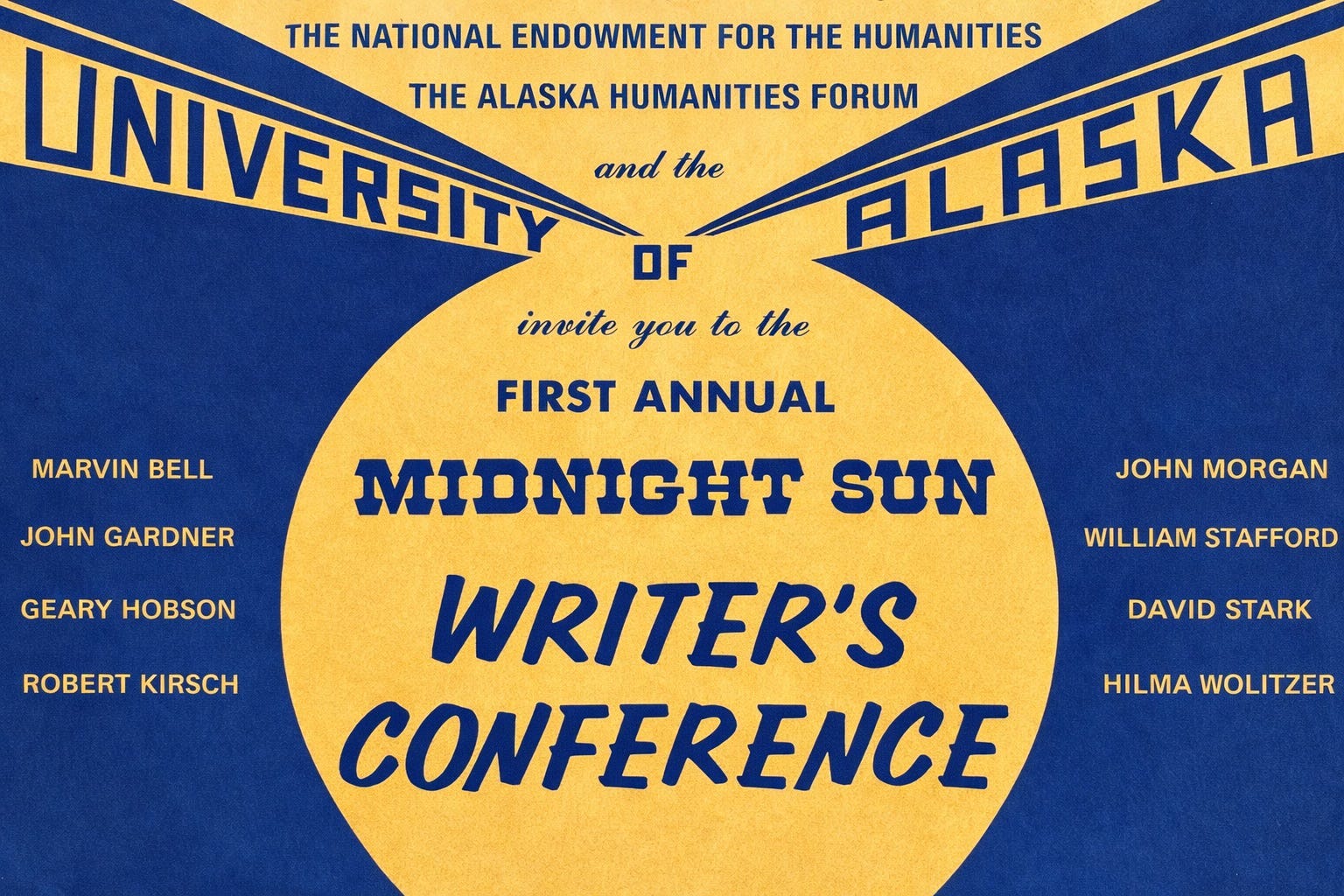
The First Annual Midnight Sun Writer’s Conference. It was co-sponsored by The National Endowment of the Humanities and the university. I still marvel at how lucky I was to have stumbled into it.
One of the instructors at the conference was novelist Hilma Wolitzer, who had come up from New York. She was great—an excellent instructor in the classroom and at the conference.
Two poets, William Stafford and Marvin Bell, met at that conference and later began exchanging poems with each other. Those y poems eventually became the book Segues: A Correspondence in Poetry.
Segues: A Correspondence in Poetry is a 1983 book by poets Marvin Bell and William Stafford, featuring a collection of poems they exchanged as “verse letters” to each other, exploring themes of friendship, family, and storytelling. The idea for the collaboration came from a 1979 conference, and the poems were written over the next two years, offering a unique look into their creative dialogue.
The cover of the flyer sent out for the conference — I still have it.
That always seemed pretty amazing to me—that something important in literature had quietly started in the same rooms where I was sitting. Another guest instructor was novelist John Gardner, a Guggenheim Fellow, who shared plenty of wisdom about writing and craft.
But the teaching moment I remember most came from William Stafford. He told us about a poem he had written early in his career. He had submitted it everywhere—magazines, journals, poetry reviews.
Rejected. Again. And again. And again.
Finally some tiny publication accepted and published it. Then he smiled and told us something I wish I had remembered more often in my life. Some people write for twenty years and never publish anything, he said. But if you’ve been writing for twenty years, you are a writer. Other people don’t get to define that for you.
You do.
1979: A World in Motion
While I was watching baseball at midnight in Alaska and trying to figure out my own future, the world was shifting in ways most of us didn’t fully grasp at the time. Looking back, 1979 turned out to be one of those hinge years in history.
Major Moments of 1979
• Iranian Revolution & Hostage Crisis – Iran’s monarchy collapsed early in the year, and by November militants seized the U.S. embassy in Tehran, holding American diplomats hostage for 444 days.
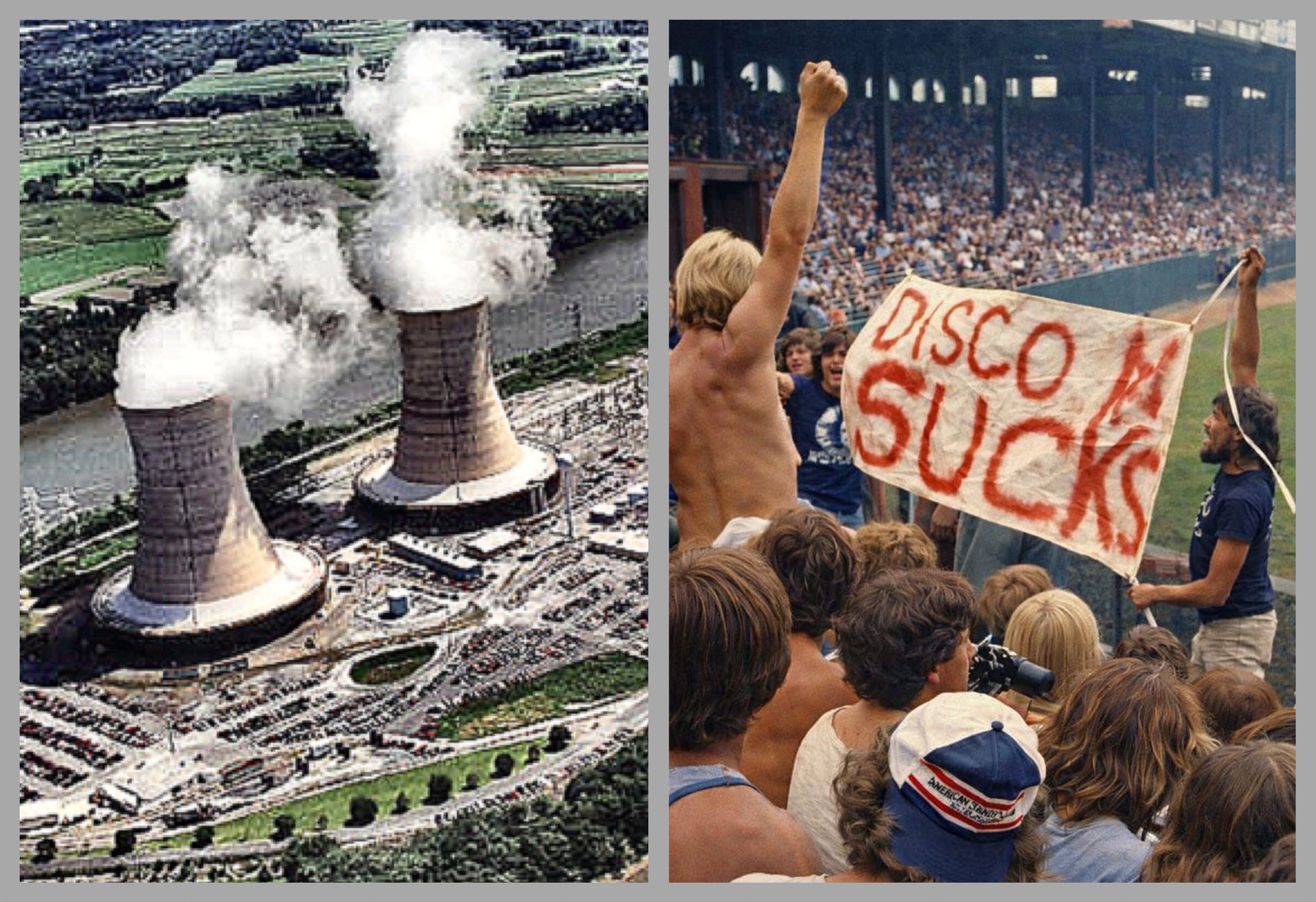
• Three Mile Island – The worst nuclear accident in U.S. history occurred in Pennsylvania, shaking public confidence in nuclear power.
• Margaret Thatcher Becomes Prime Minister – Britain elected its first female prime minister, ushering in a new era of conservative politics.
• Pope John Paul II Visits the United States – The charismatic Polish pope drew massive crowds and became a global political and spiritual figure.
• China’s “One Child Policy” Begins – A population control policy that would reshape Chinese society for decades.
• Soviet Union Invades Afghanistan – The invasion in December triggered a long conflict and intensified Cold War tensions.
• Disco Demolition Night – A chaotic baseball promotion in Chicago turned into a riot and symbolized the cultural backlash against disco music.
Three Mile Island and Disco Demolition Night. AI GEN
Leaving Alaska
Even though at the time it felt like the longest summer ever, it was over quickly.
At the end of the first week of August, my dad put me on an Alaska Airlines flight to Seattle. After a long layover—he always booked long layovers into my flights—I boarded a Northwest Airlines flight for Kansas City.
People were still smoking on airplanes then. And drinking. I did both. When we landed at Kansas City International, the Midwest looked gray and tired. The grass around the airport was burned brown. The sky felt flat and heavy compared to the dazzling blue I had gotten used to in Fairbanks.
Two months of Alaska had spoiled me.
The Kansas City humidity was brutal—the temperature around ninety degrees. And the people in the airport seemed oddly sharp-edged compared to the easygoing indifference of Alaskans.
I was home.
Home to another semester of mediocre academic work. Home to losing myself again. Home to bad decisions that were very easy to make.
Looking Back
Over the years I’ve wondered more than once if Fairbanks might have been the place I should have stayed longer. The people there accepted me even when I was immature and unsure of myself. Maybe if I had slowed down and really embraced that place, things might have turned out differently.
You might not be reading this right now.
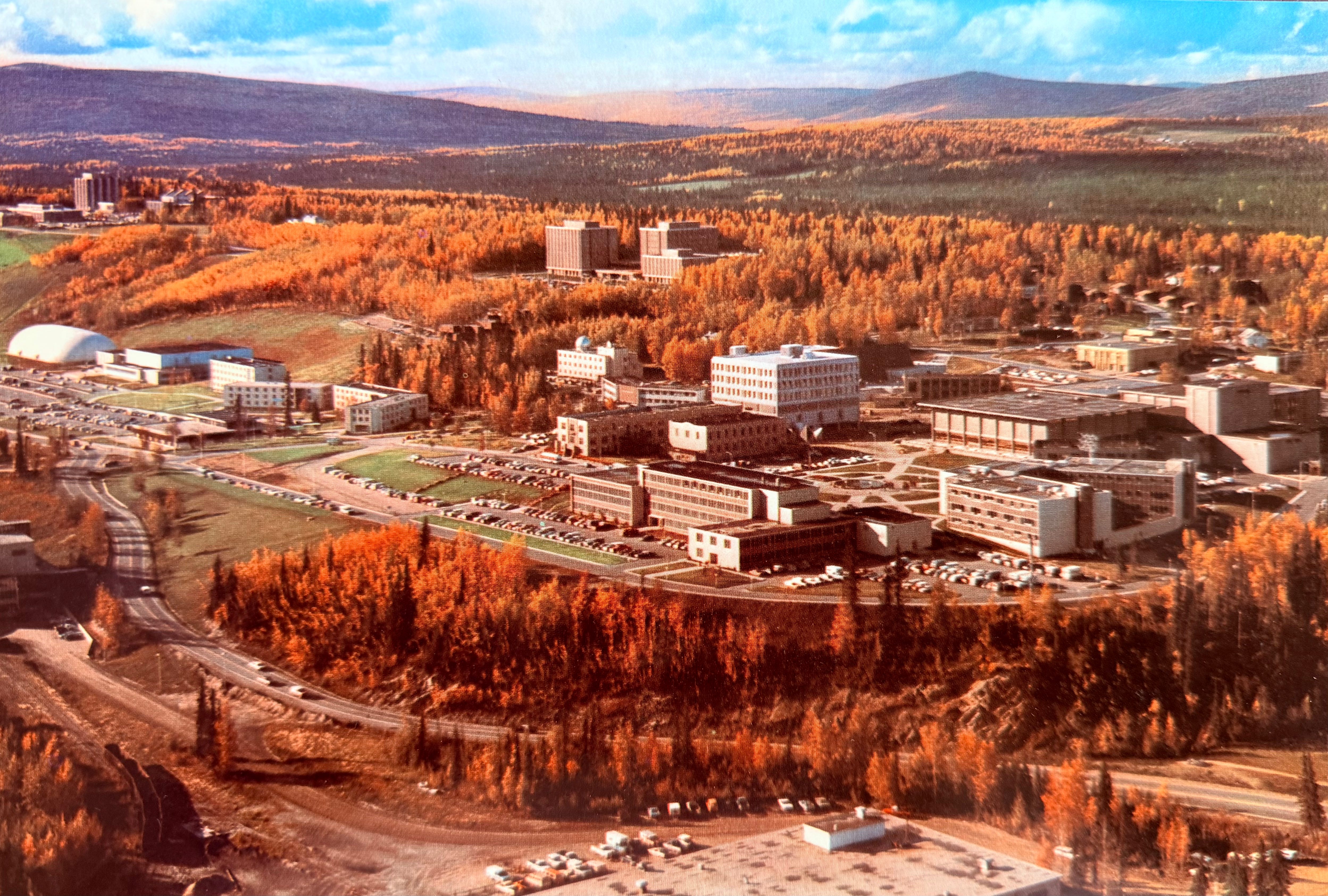
The University of Alaska Fairbanks turned out to be a remarkable place. I never imagined decades later I would be writing about the school, the state, and the people who influenced me there. Back at Kansas I made wrong turns. I trusted the wrong people. I made bad decisions.
The University of Alaska Fairbanks, circa 1979.
So what. Everyone does. And looking back on Alaska now feels like a kind of quiet healing. I’ve forgotten who I was many times in my life. But somehow I’ve always managed to find pieces of that person again.
Usually just in time.
Double Midnights
A midnight baseball game and a writers’ conference converged on me in the tumultuous but still watershed year of 1979.
And somehow those two things—one played on a field under a sky that never went dark, the other inside classrooms filled with strangers who wanted to become writers—ended up shaping far more of my life than I understood at the time.
Looking for myself in the fall of 1979?
Hell. Maybe I’ve been looking ever since.
Time Always Circles Back
My Double Midnights were good—memories that still resonate in a positive way.
But the other memories of 1979? Iran. The oil crisis. The uneasy feeling that something in the world had shifted. That November, Iranian students stormed the U.S. Embassy in Tehran and took 52 Americans hostage, holding them for 444 days while the country watched the clock tick every night on television and held their breath.
I remember thinking then—without really understanding why—that time itself had changed.
The question now is the same one that hung over that year: Will the clock keep ticking… or… ?
The Stallard Blurb is reader-supported. To receive new posts and support my work, consider becoming a free or paid subscriber.
Thanks for reading! This post is public so feel free to share it.