He’s still saying it out loud. Not the quiet version. Not the cleaned-up, briefing-room version. Not the version with bullet points and acronyms and a flag behind the podium. The real version.
“Blowing shit up.”
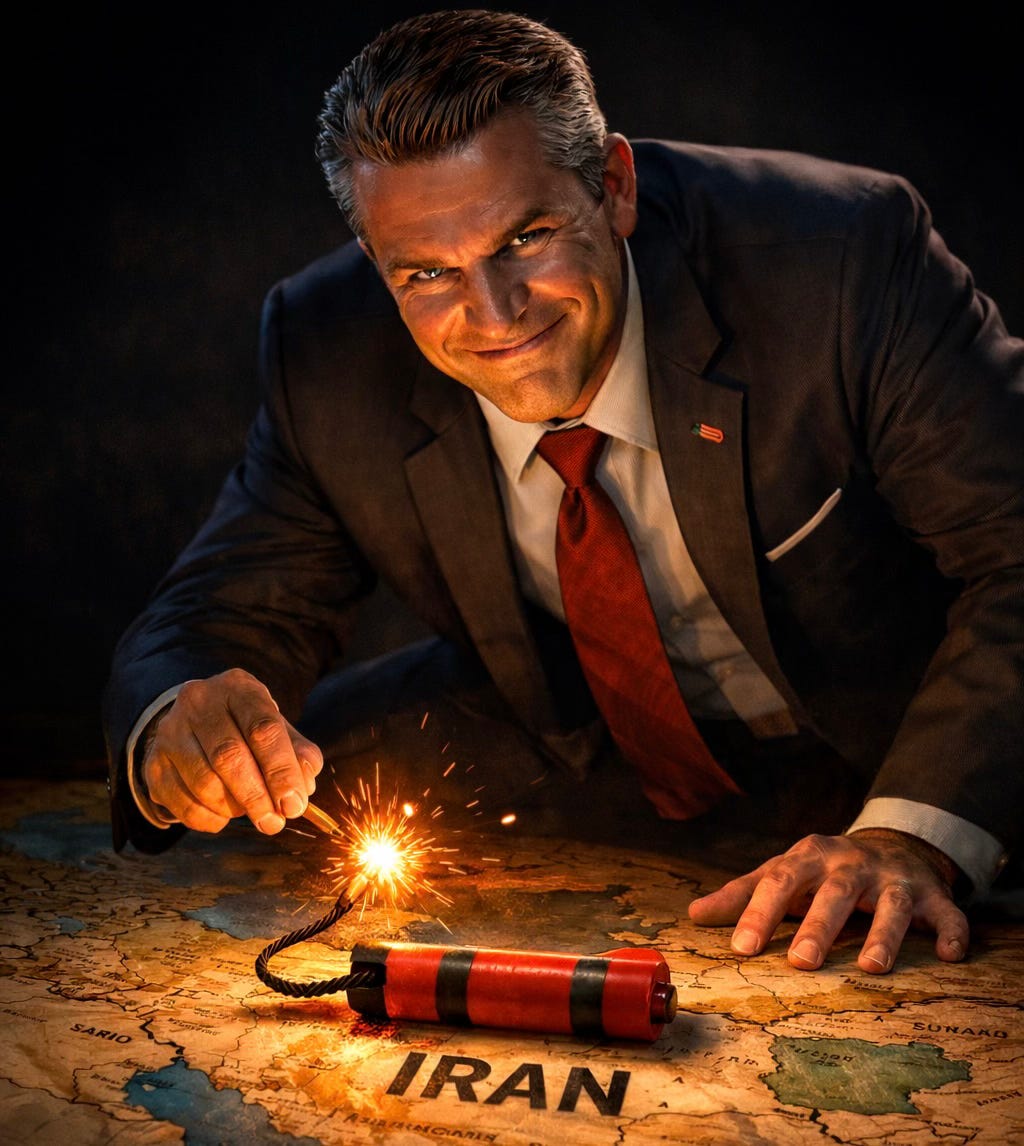
That’s the phrase tied to Pete Hegseth’s thinking, according to reporting—his belief that the surest way to keep his job safe is to stay visible, stay aggressive, stay useful in the oldest way Washington understands: kinetic, loud, undeniable.
Not national security. Personal security. And maybe that’s the cleanest sentence in this whole mess. Because once you understand that—once you understand that war can be a résumé builder—you start to hear everything else differently.
“Blessed be the Lord, my rock, who trains my hands for war and my fingers for battle,” said Pete Hegseth. And the fuse to war was lit. AI GEN
Why Are We at War with Iran?
The official reasons come in layers: stop a nuclear threat, weaken Iran’s missiles and military reach, protect U.S. forces and allies, and push back against Tehran’s influence across the Middle East. The immediate trigger was a joint U.S.–Israeli strike on Iran’s nuclear facilities and leadership after years of rising tension over Iran’s nuclear program and regional power plays.
But even inside the government, the reasons aren’t always that clean or consistent. Depending on who’s talking, the war is about deterrence, regime change, preemption, or opportunity—sometimes all at once. And that’s where it gets murky. Because when the “why” keeps shifting, it’s harder to define what winning even looks like—and easier to keep the fight going without ever fully explaining it.
Or is it the Epstein files? And where is Congress in all of this?
The Sales Pitch
“We’re going to go on offense… maximum lethality, not tepid legality… violent effect, not politically correct.”
That’s not policy language. That’s branding. That’s a tagline.
You can almost see it running across the bottom of a cable news segment, slapped between a graphic and a commercial break, bold font, dramatic music underneath. It doesn’t explain anything. It doesn’t need to. It sells a feeling.
Strength. Action. Certainty. And certainty is what sells.
Because war, when it’s introduced properly, doesn’t arrive as chaos or grief or consequence. It arrives as clarity. It arrives wrapped in phrases like “victory” and “defense” and “resolve.” It arrives as something clean.
It has to. Otherwise, no one buys it.
The Stallard Blurb is reader-supported. To receive new posts and support my work, consider becoming a free or paid subscriber.
Comfortable Inside the Violence
“In this profession, you feel comfortable inside the violence…” That might be the most honest thing he’s said. Not cautious. Not burdened. Not reluctant.
Comfortable.
There was a time—not even that long ago—when leaders at least pretended that violence was a last resort, something approached with hesitation, something that carried weight. You didn’t have to believe them, but the language mattered. It acknowledged something human. Now?
Comfort is the pitch. Violence isn’t the cost. It’s the product. And if you can make it sound strong enough, clean enough, necessary enough, then the cost disappears behind the words.
It always has.
Say the Prayer
At a press conference, Hegseth reached for scripture. Psalm 144. A prayer for strength. Protection. Victory.
“May the Lord grant unyielding strength and refuge to our warriors… and total victory over those who seek to harm them. Amen.”
It sounds right. It always sounds right. That’s the point.
Because once you wrap violence in something sacred, once you lift it into the language of God and country and righteousness, you don’t just justify it—you absolve it. You don’t have to explain what victory means. You don’t have to explain what it costs. You just have to say amen.
Then you order the relentless bombing of Iran.
What Happened to the Epstein Files?
They were going to crack something open—the names, the networks, the money and power that didn’t just brush past Jeffrey Epstein but moved comfortably inside his orbit. For a moment, it felt like the story might actually force its way through. Then the oxygen shifted. New headlines, new urgency, a different kind of fire to watch. War has a way of doing that — it doesn’t just dominate attention, it replaces it. The files didn’t disappear. They were displaced.
And that’s the quieter mechanism at work. You don’t have to bury a story if you can outsize it. Roll something louder, bigger, more immediate across the screen, and the rest fades on its own. The questions don’t get answered—they get crowded out. What remains isn’t closure, just a lingering outline of what might have been revealed, had the world not been given something else to look at.
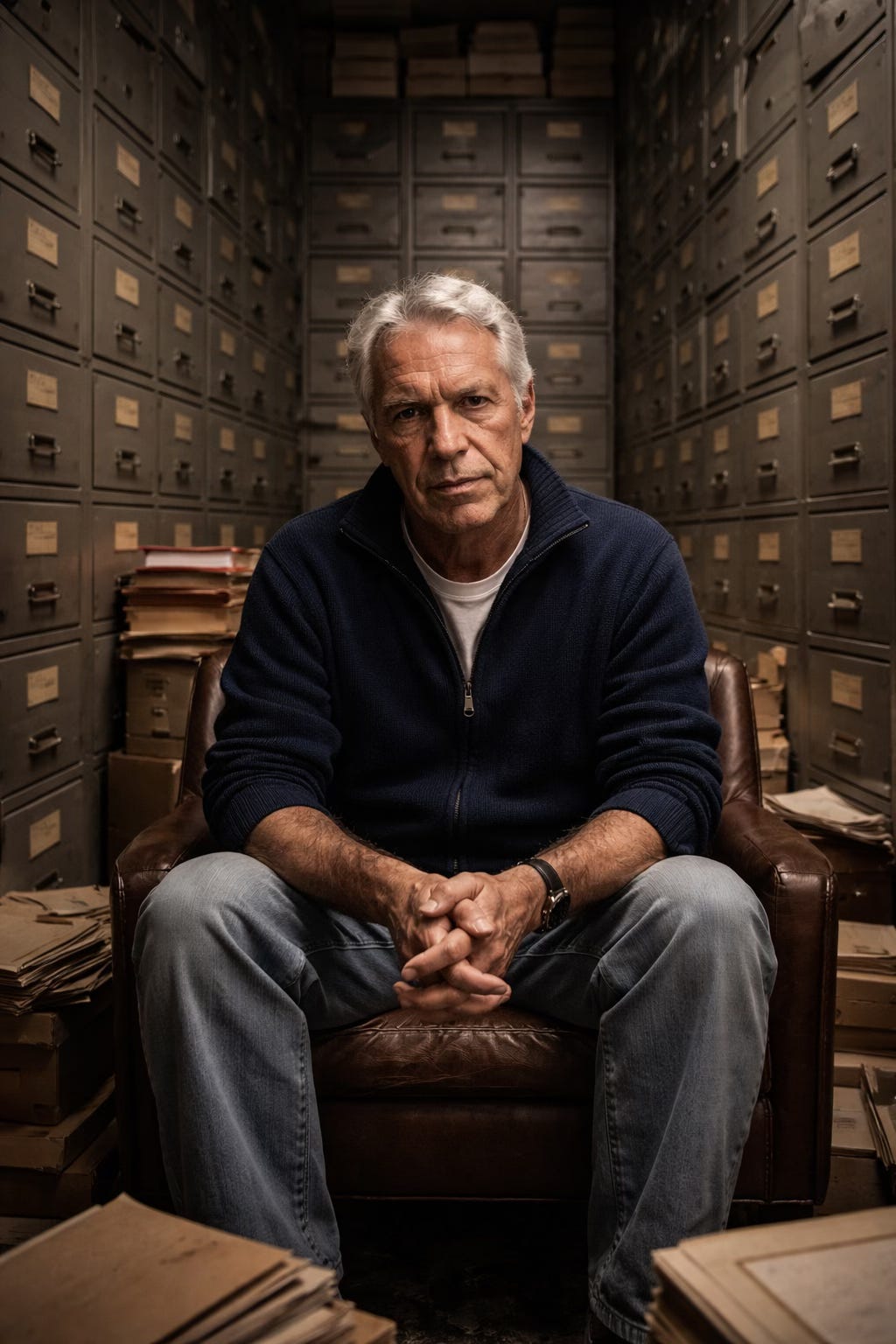
The Epstein files wait for a complete, unredacted release. AI GEN
We’ve Heard This Prayer Before
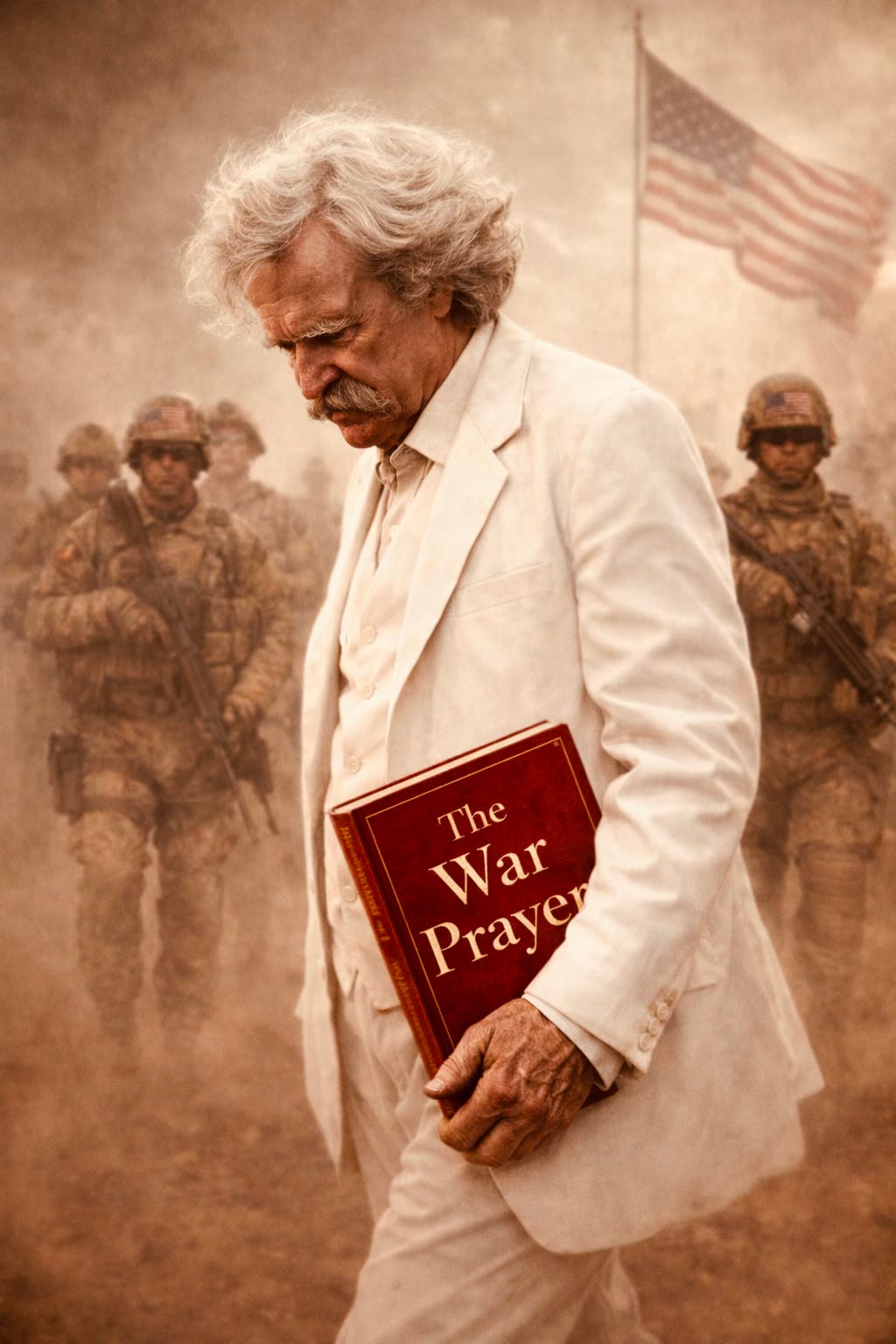
More than a century ago, Mark Twain wrote something they didn’t want published in his lifetime. Not because it wasn’t true.
Because it was.
He called it The War Prayer. And he didn’t change the prayer. He translated it.
Thanks for The Stallard Blurb! This post is public so feel free to share it.
It was a time of great and exalting excitement. The country was up in arms, the war was on… the churches were full, the pastors preaching devotion to flag and country, invoking the God of Battles, beseeching His aid in our good cause…
And then, in Twain’s telling, a stranger appears. Not to oppose the prayer. Just to finish it.
“I come from the Throne — bearing a message from Almighty God… You have prayed a prayer. It is one prayer… but it is two. One uttered, the other not.”
And then he speaks the second one. The one no one says out loud.
“O Lord our God, help us to tear their soldiers to bloody shreds with our shells; help us to cover their smiling fields with the pale forms of their dead; help us to drown the thunder of the guns with the shrieks of their wounded; help us to wring the hearts of their widows with unavailing grief; help us to turn them out, roofless, with their little children to wander in rags and hunger… for our sakes who adore Thee, Lord, blast their hopes, blight their lives, stain the white snow with the blood of their wounded feet.”
That’s the prayer. That’s what “victory” asks for. Here’s a link to the complete text of The War Prayer.
Translation
Hegseth says “maximum lethality.” Twain says: torn bodies.
One is the language we use. The other is the language we avoid. And the distance between those two is where war lives.
The Part We Don’t Say
We don’t call it slaughter. We call it strength.
We don’t call it grief. We call it resolve.
We don’t call it ambition dressed up as patriotism. We call it leadership. And when someone tells us—plainly, without slogans, without scripture, without the protective coating of language—what we’re actually asking for… we don’t argue with him. We dismiss him.
The Lunatic
Twain ends it simply. After the stranger speaks — after he lays bare the second prayer, the real one — the crowd doesn’t wrestle with it. They don’t debate it. They don’t even really hear it. They explain it away.
“It was believed afterward that the man was a lunatic, because there was no sense in what he said.”
Of course he was. He said the quiet part out loud.
Twain’s The War Prayer remains a timeless observation of the brutality, inhumanity, and stupidity of war. AI GEN
The Cost So Far
Thirteen Americans are dead. A few hundred more are wounded—burned, broken, and sent home in pieces that don’t show up in press briefings. On the other side, more than a thousand Iranians are gone, many of them civilians, their names mostly unknown, their deaths folded into phrases like targets hit and objectives achieved.
And even now, the numbers feel slippery. They shift, they lag, they depend on who’s counting and who’s talking. Which tells you something. Because when the math of war isn’t clear, the truth usually isn’t either. We don’t just lose people—we lose the full accounting of what’s been done in our name.
Amen
“Blowing shit up” isn’t strategy. It’s a slogan. A career move. A way to stay visible in a system that rewards noise over thought and action over consequence.
But behind every slogan, there’s always a second version. The one we don’t print. The one we don’t pray. The one we don’t say out loud. Unless someone like Twain does it for us.
And when he does? We call him crazy, close the book, and go right back to saying amen.
The Stallard Blurb is reader-supported. To receive new posts and support my work, consider becoming a free or paid subscriber.