It was warm for early May in Wichita, the low 80s, and I remember thinking that that felt like a gift. When I got home from school—sixth grade—only a couple things were on my mind. My birthday was just over a week away. School would be out soon. And that night, the New York Knicks and Los Angeles Lakers were set for Game Five of the NBA Finals.
Then the NBC Nightly News came on in the late afternoon. David Brinkley’s delivery was matter-of-fact—too calm for what it was: the shootings at Kent State. And just like that, I forgot about basketball.
Kent State University in Ohio, has had campus violence for three nights, causing the National Guard to be called in, and today the guardsmen opened fire on the students, killing four of them, two young men and two young women, three were shot in the chest and one in the head. A dozen or more others were wounded, some by gunfire and some by bayonets.
Bayonets? One of the early lies of major disinformation spewed out about the shootings.
That was the beginning of it for me—a strange mix of fascination, horror, and sadness I still can’t quite slap a name on. The event has echoed through more than five decades of our country’s history, and somehow, the lesson—the terrible, obvious lesson—has never landed anywhere that made us better.
The Protests
The student protests that culminated with the Kent State shootings were not just about one decision—they were the boiling point of years of anger. The immediate trigger was President Richard Nixon announcing the expansion of the Vietnam War into Cambodia in late April 1970. To many students, that move felt like a betrayal. Nixon had campaigned on winding the war down, yet here he was widening it. On campuses across the country, protests erupted against what students saw as an illegal and reckless escalation, carried out without clear congressional approval and at the cost of more American and Vietnamese lives.
But beneath Cambodia was something deeper. By 1970, opposition to the Vietnam War had grown into a broader moral and generational revolt. Students were protesting the draft, which they believed unfairly targeted young and working-class men; the mounting death toll; and the sense that the government was misleading the public about the war’s progress and purpose. There was also a growing distrust of authority—of politicians, the military, and even universities tied to defense research. Cambodia didn’t create the movement—it exposed the raw nerve. What happened at Kent State was the moment that tension, frustration, and fear collided in the open—under the direction of Ohio Governor James A. Rhodes, a man who escalated the situation with inflammatory rhetoric and force, the Kent protest turned into a deadly confrontation.
In the days following the Kent State shootings, the reaction was immediate and nationwide. More than 400 campuses erupted—shock, anger, and grief engulfed the nation’s higher education institutions. Students walked out of classes, organized mass strikes, and filled quads and streets with protests that stretched from small colleges to major universities. It became the largest student strike in American history, with millions refusing to attend classes, effectively shutting down parts of schools. What had been opposition to the war now fused with outrage over the killings themselves—students weren’t just protesting policy anymore, they were protesting the idea that their own government could turn its guns on them.
The Stallard Blurb is reader-supported. To receive new posts and support my work, consider becoming a free or paid subscriber.
The Shootings
Kent State University was a campus that looked like a lot of others at the time, full of students trying to figure out what the hell was going on in the world around them. The protests had been building for days after the U.S. expanded the Vietnam War into Cambodia. Nothing unusual for that moment in history—campuses all over the country were pushing back. But things escalated, and after the ROTC building on campus was burned, Ohio’s governor called in the Ohio National Guard.
Guns on a college campus. That alone should’ve been a warning.
On that May 4 Monday afternoon, students gathered again. And there was the Guard. Tear gas was fired. Some students threw rocks. Most just stood there, watching, yelling, trying to make sense of it. And then, in a span that barely registers as time—13 seconds—the guardsmen turned and opened fire.
Sixty-seven shots.
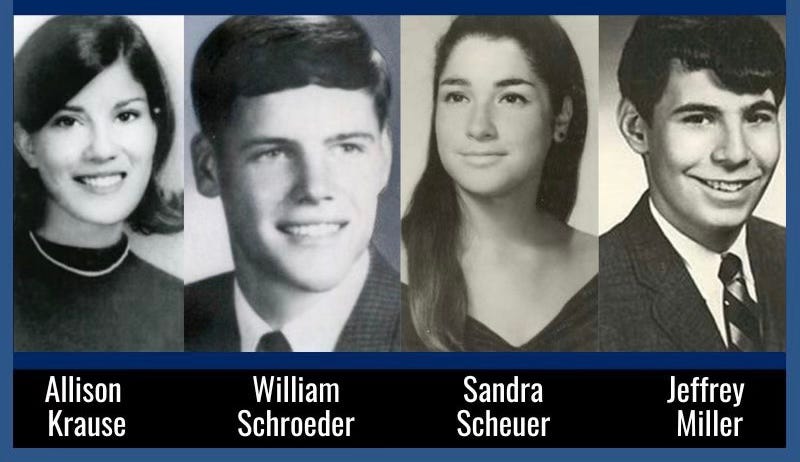
Four students were killed: Allison Krause, William Knox Schroeder, Sandra Scheuer, and Jeffrey Miller.
Nine others were wounded. Some of them weren’t even protesting—just walking to class.
That’s the part that never leaves you. This wasn’t a battlefield. It was a college campus. And for 13 seconds, it became something else entirely.
Hard Hat Idiots
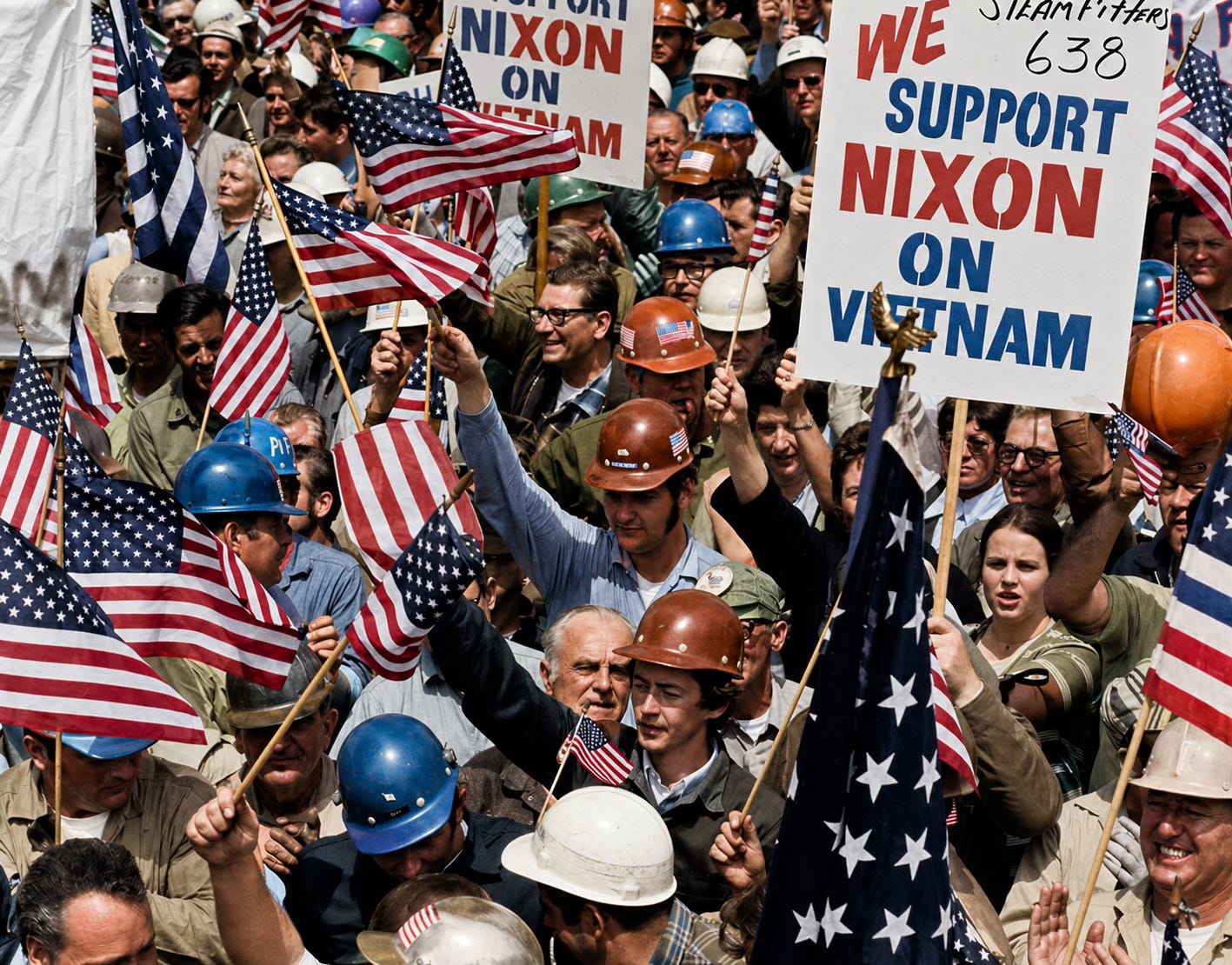
On May 8, 1970—just days after the Kent State shootings—tensions boiled over in New York during the Hard Hat Riot. What began as a peaceful student protest turned violent when construction workers charged the crowd, beating demonstrators with hard hats, tools, and fists while waving American flags. Police response was minimal, and the scene quickly became chaos—Americans attacking Americans in broad daylight.
Hard Hat riot. AI GEN
The riot revealed how deeply divided the country had become. To many workers, the students were unpatriotic; to the students, the attack showed just how dangerous dissent had become. Instead of unity after Kent State, the country fractured even further.
The Print Media
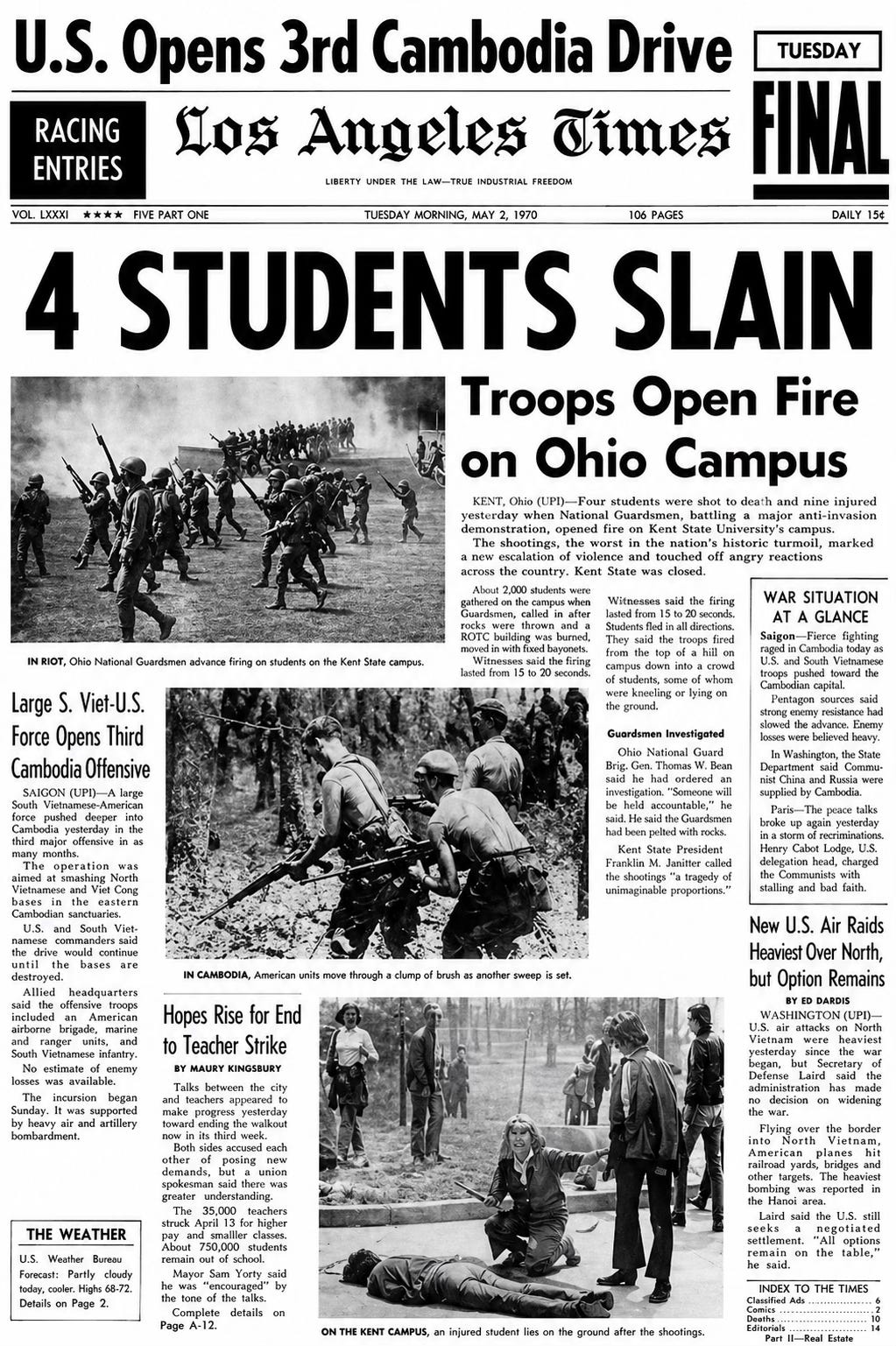
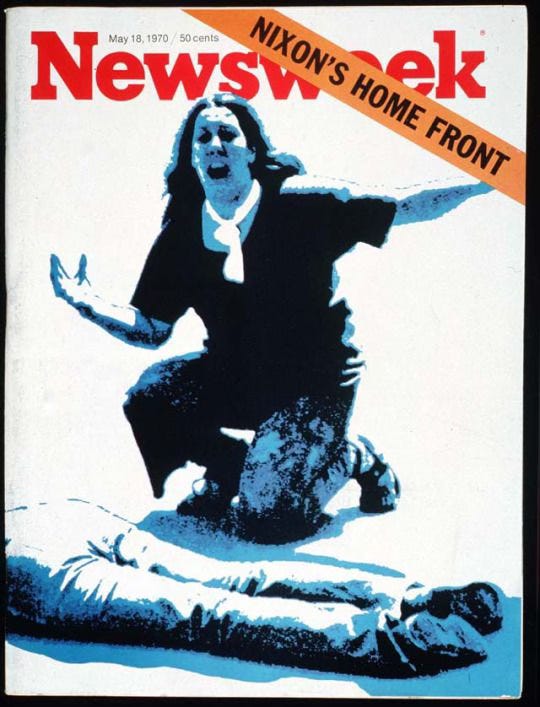
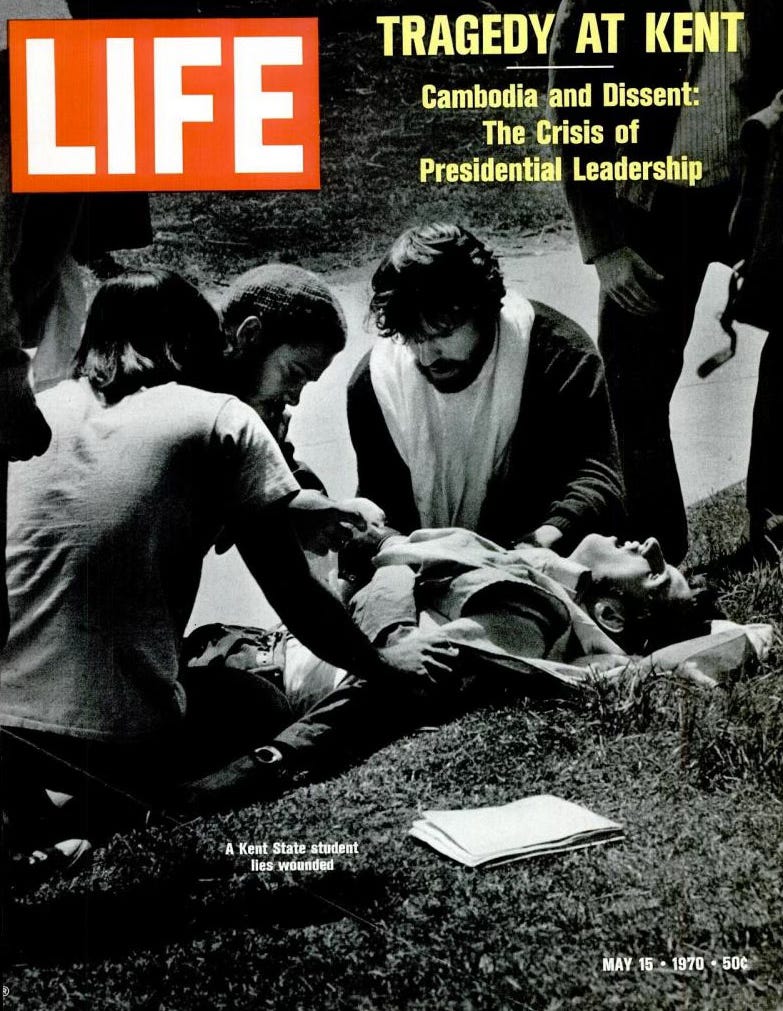
Everyone’s seen the famous photo of the girl kneeling next to Jeff Miller’s body. Here are the covers of a few of the publications and how they presented the story to America.
“Four Dead in Ohio”
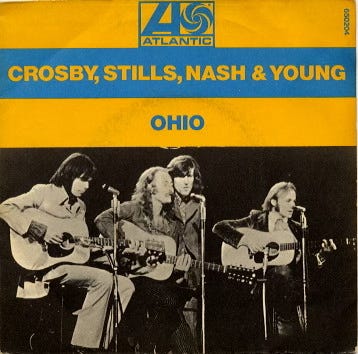
That’s shorthand for the shock that followed the Kent State shootings—but it became immortal through the song Ohio by Crosby, Stills, Nash & Young. Written almost immediately by Neil Young after seeing photos of the aftermath, the song captured something raw and unresolved. It wasn’t polished or distant; it was urgent, accusatory, and grieving all at once. The repeated line—“four dead in Ohio”—lands like a tolling bell, refusing to let the country look away from what had just happened on an American campus.
More than just a protest song, “Ohio” became a cultural flashpoint. It called out power directly, referencing Richard Nixon and the widening distrust between citizens and government during the Vietnam War. Radio stations debated whether to play it; young people didn’t debate at all—they blasted it. The song turned a moment into memory, and memory into something permanent. Decades later, those four words still carry the weight of that day—less a lyric than a verdict, echoing across generations that continue to wrestle with protest, authority, and the cost of escalation.
For me, the song always hits hard—we listened to a lot during my college years.
Kent State Books
James Michener’s Kent State: What Happened and Why was my first journalistic look at the event. But critics were not kind to this work, pointing out several issues with his fact-gathering and writing methodology, including:
Factual Inaccuracies and Fictional items
Failed Objectivity
Misleading Quotes and Sources
“What Happened” Discrepancies
Ignoring Key Evidence
These are the top-rated books on Kent State:
Kent State: An American Tragedy by Brian VanDeMark
67 Shots: Kent State and the End of American Innocence by Howard Means
Kent State: Death and Dissent in the Long Sixties by Thomas M. Grace
Above the Shots: An Oral History of the Kent State Shootings by Craig S. Simpson & Gregory S. Wilson
When Truth Mattered: The Kent State Shootings 50 Years Later by Robert Giles
Thirteen Seconds: Confrontation at Kent State by Joe Eszterhas & Michael D. Roberts
Kent State: Four Dead in Ohio (Graphic Novel) by Derf Backderf
May 4, 1970: The Kent State Story in Pictures (Akron Beacon Journal)
Kent State by Deborah Wiles
If you were to synthesize the collective findings of these books, you would gain a “360-degree view” of the tragedy that moves far beyond a simple timeline—a real arc of the tragedy is laid out in the pages of these books.
Thanks for reading! This post is public so feel free to share it.
I was always a big Sports Illustrated fan. I had a subscription for years. My junior year of high school, the Harvard Lampoon put out a parody of the magazine, and I grabbed it pretty fast.
One of the weekly columns in Sports Illustrated recapped what happened in college football the week before—short blurbs on the big games, along with rankings of the top three teams in each region of the country.
The parody issue had its own version of that section. And at the top of the Midwest region, this is what they had:
Oklahoma’s chief rival in the Big Eight, Nebraska, had more trouble than it expected with scrappy Kent State before winning 27–8. The battle was nip and tuck through the middle of the third quarter, and for a while it looked as if Nebraska might be handed its first loss since the previous week, when one enterprising Cornhusker lit a string of firecrackers. “Don’t shoot—I give up!” screamed Kent State quarterback Jerry Sanalac, who thereupon lost the ball attempting to crawl under teammate Dwight Mazola. The Huskers didn’t have to be told twice how to handle that defensive setup, and a few “bang-bangs” proved sufficient to clear the way for six quick TD’s in the last 19 minutes of the game.
Fuck that, even if it’s satire.
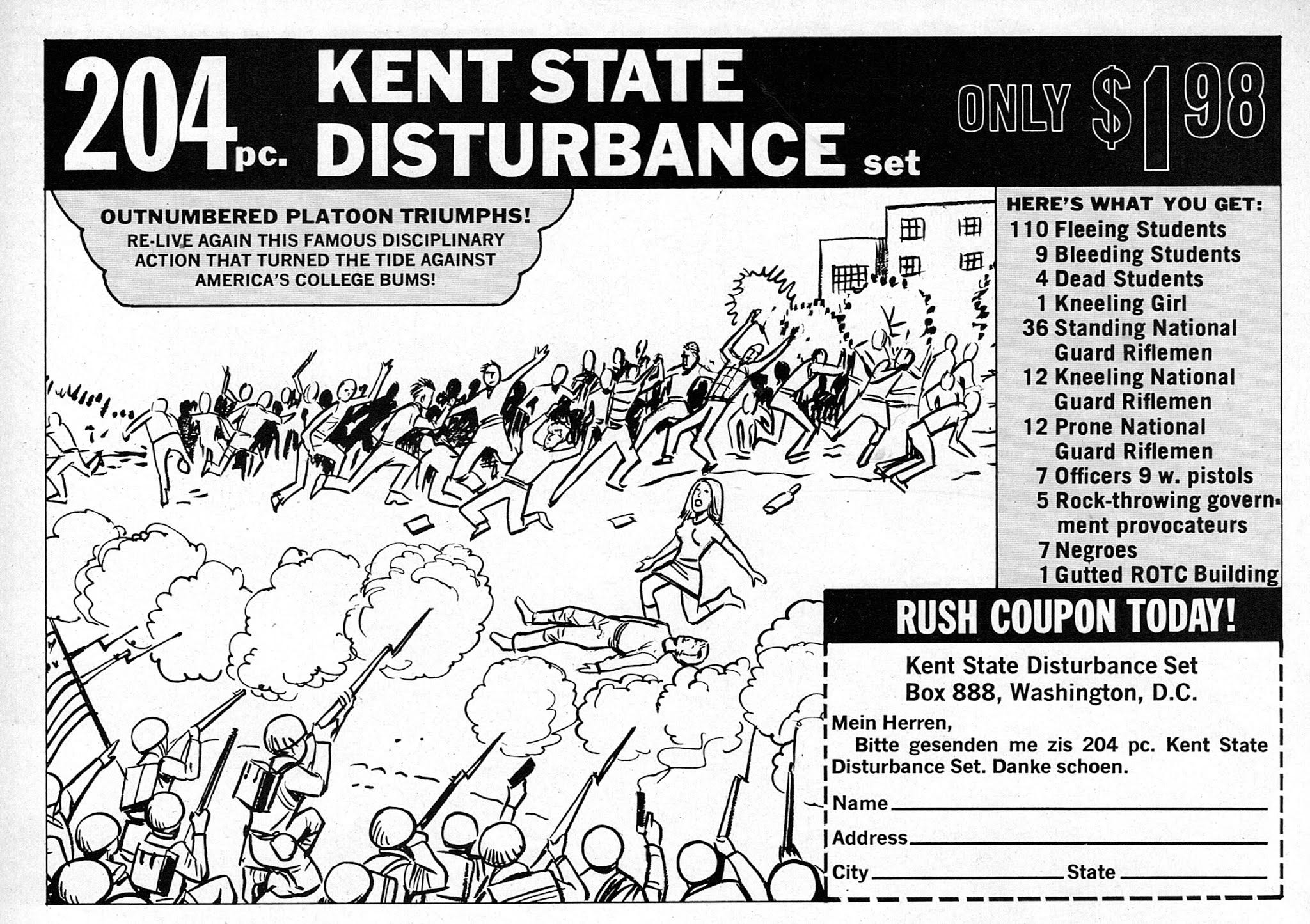
Lampoon also put out this fake ad:
More satire, and while it says a lot about the country, our move “forward-and-forget” state-of-mind, this too was a bit much. This came out in 1971.
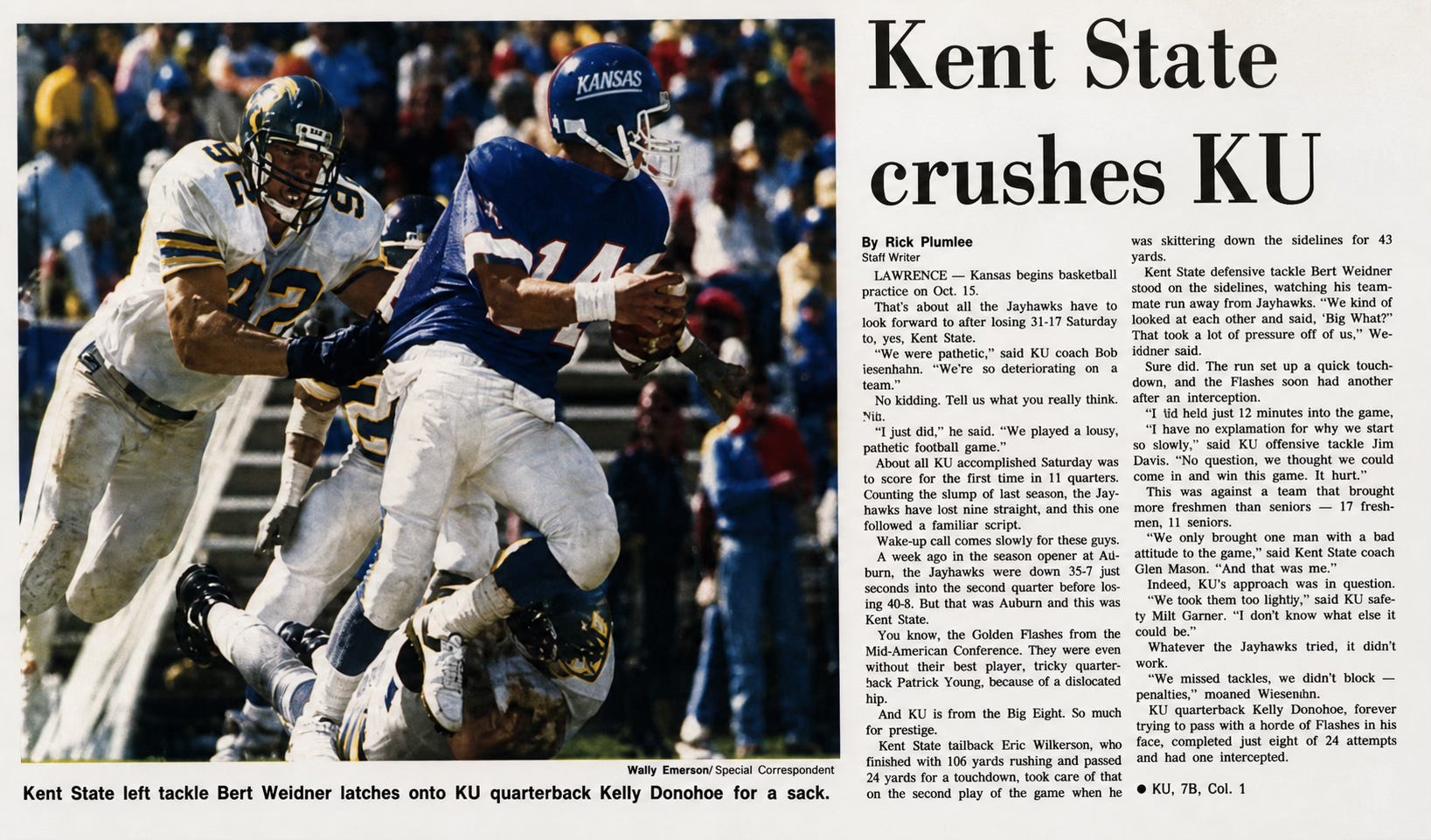
And then there’s a good thing. Kent State came into Lawrence, Kansas, in 1987 and beat the shit out of my alma mater, KU,
The beating was so severe, KU hired Kent’s coach, Glen Mason, the following season.
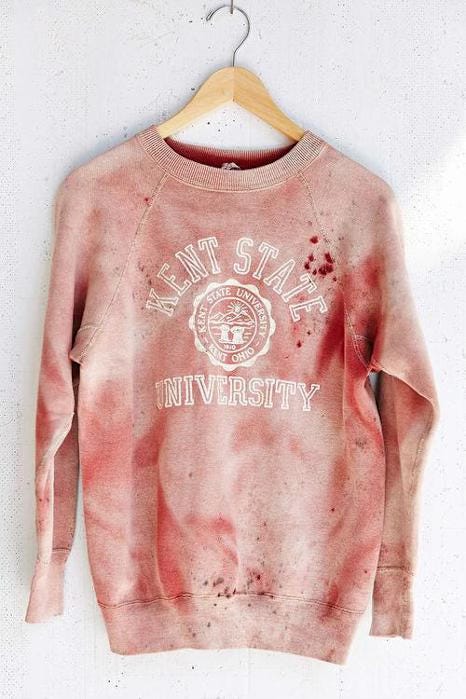
This was the one of the worst. In 2014, Urban Outfitters thought it might be fun to put out a 1970 Kent State sweatshirt.
The company drew immediate backlash for selling the sweatshirt that appeared to feature blood-like stains and what looked like bullet holes—imagery widely interpreted as evoking the Kent State shootings. Critics accused the company of trivializing the deaths of four students by turning a real tragedy into a distressed fashion aesthetic. Urban Outfitters claimed the markings were simply part of a randomly sourced vintage garment, but the explanation was met with skepticism and a lot of outrage—the item was quickly pulled.
A Kent State Reflection by Kathleen Stallard
I attended Kent State University at a time when most students had only been infants—or not yet born—when Kent State shootings happened.
The day was never ignored. During freshman orientation, we were required to take a May 4th class. There was a dedicated room in the library. Every year brought vigils and commemorations.
But the memorial wasn’t there yet.
What I remember most are the families who would return. To us, 1970 felt impossibly distant. But when they looked at us, they weren’t seeing the present—they were seeing the age their loved ones would always remain. Frozen in time. I didn’t fully understand that then. I was mostly standing around, waiting for the band to play.
I was an art student at the time, and the proposed memorials were often discussed in class. I remember being drawn to a powerful “David and Goliath” submission by George Segal. It was intense, confrontational, violent, even. The university rejected it. It wasn’t what they wanted the space to hold.
Instead, they chose something quieter, four simple marble stones resting peacefully on a hill. I remember feeling underwhelmed. But time has a way of reshaping perspective.
Now, I understand that the university made the right choice. The space invites stillness. It asks you to sit, to reflect. And for those who lived through that day, for the families who return, it offers something more important than a statement or spectacle. It offers peace.
So if I had to summarize what Kent State means to me, it is how important it is to allow yourself to grow your point of view over time. The University has grown considerably which has allowed me to refocus the lens, bringing clarity to my time there, my time after, and how I approach my life.
Commons, After
April leaked into May—ash in the hedges, sirens stitched to the wind; a dry taste of orders on the tongue of the afternoon. Books lay open to margins of doubt. The hill kept its silence, a grammar of distance no voice could decline.
They moved like weather—helmets, breath, a line—and the air took fire. Thirteen seconds, unanswerable, measured the space between bodies and names.
Allison. Jeffrey. Sandra. William.
The syllables fell and would not return; the clock went on without them. After, the grass held what the mouth could not—rumor of a reason, the thin claim of a sniper, the long labor of forgetting that fails. Even now the wind rehearses it, turning the Commons into a question the country cannot finish.
Still, Kent State endures…and thrives.
My wife Kathleen went to Kent State, and over time I’ve adopted Kent State as one of “my” teams, schools. We’ve seen them play basketball against KU at Allen Fieldhouse, and we’ve followed the football program, too. A few years back we watched them in the MAC Championship game. But what really pulled me in was the 2019 The Tropical Smoothie Cafe Frisco Bowl. Kent State won its first-ever bowl game that night, and I’ve been following them ever since.
I’ve been to Kent a few times and love the campus and the town. The most meaningful part of those visits has been seeing the memorial—the history, and the places that matter to my wife.
I like wearing Kent State T-shirts. And I can’t tell you how many times someone sees it and asks, “Kent State… is that where the shooting happened?” I’m always polite about it. The better moments are when someone comes up and says they’re from Ohio, or that they went there. That happens more often than you’d think here in Kansas City.
I’ve thought a lot these past few weeks about what the Kent State shootings can mean for us today—what it should have taught us, what it might still offer. My conclusion is a hard one: not much. We didn’t learn what we should have. In some ways, we’ve gone backward. The protests we’ve seen over the past year, the heavy-handed responses, the tension between authority and citizens—it all feels familiar in the worst way. Different issues, different names, but the same underlying question still hanging there:
What happens when power refuses to listen?
And what happens when people decide it never will?
The Stallard Blurb is reader-supported. To receive new posts and support my work, consider becoming a free or paid subscriber.