

Red, White, and Almost True
A Bicentennial Fourth of July and the Feeling That Anything Was Possible

Every summer, about a week before the Fourth of July, we’d start bugging our parents: Fireworks! Fireworks! Let’s go get our fireworks! The stands would pop up around the edges of town—white tents on gravel lots, painted signs flapping in the hot wind—and finally Mom or Dad would take me and my sisters out to pick through the boxes of Black Cat firecrackers, sparklers, snakes, fountains.
And it never felt like we got enough. Never ever enough. Like maybe we’d come home with just one firecracker and one sparkler—of course that’s a wild exaggeration, but in life—with fireworks, at least—it always felt that way. Whatever you were given, it burned out too soon. We wanted it to last forever.
On the morning of the Fourth, we’d wake up early, so wired with excitement we could hardly stand it. We’d run out to the driveway and start lighting firecrackers, dropping little smoke bombs that sputtered and stained the concrete blue and gray and black, making the snakes curl and hiss on the sidewalk. I didn’t understand the full significance of Independence Day, and it didn’t matter. We were happy because—fireworks. Happy because there was nothing to do but set things on fire and laugh.


Sometimes we’d go to my grandparents’ house, the whole family together—uncles in lawn chairs, aunts carrying bowls of potato salad, cousins chasing each other with sparklers at dusk. Back then there weren’t many big municipal fireworks shows, so everybody had their own little stash—fountains, skyrockets, Roman candles. One of my uncles would walk around during the day, cigarette in hand, lighting firecrackers right off the end of it like it was the most natural thing in the world. We’d have those skinny sticks that smelled like sulfur and burned down slow so you could light one fuse after another without a match. We’d all run around taking turns with the punks, waiting for that bang of the firecrackers and, later, the whoosh of the fireworks.
One year, I must have been about five, and one of my cousins was even younger. We were all waving sparklers—me, my sisters, my other cousins—and my little cousin wanted one so badly. His mom lit one and carefully tried to hand it to him. He was so excited he grabbed the burning end, and let out a scream that split the summer night in half. Boom—Happy Fourth of July (his hand was OK).
Take a break now and pull in the soul of Ray Charles, something the country desperately needed after 9/11. He opened the second game of 2001 World Series with the second stanza of “America the Beautiful,” a deliberate choice to highlight unity and rebuilding. Lines like “Confirm thy soul in self-control, Thy liberty in law” echoed the nation’s mood.
I graduated from high school in 1976, the year of the Bicentennial. I still didn’t fully understand what our nation’s history was, what it had been, or where it was going. But that summer, it felt good. It felt uncomplicated. I was in Nebraska, and for reasons I still can’t quite explain, it felt like something was possible—for me, everything was possible. Like the country had decided to take a breath, look around, and imagine a different kind of future.
America started celebrating the Bicentennial in 1975 and carried it all the way into July of ’76. People painted barns red, white, and blue. Kids wore shirts with the Liberty Bell and those old colonial flags. There were commemorative coins and special stamps, Bicentennial Minute broadcasts on TV every night. Some of it was corny, sure—but some of it was hopeful in a way we haven’t really seen again.
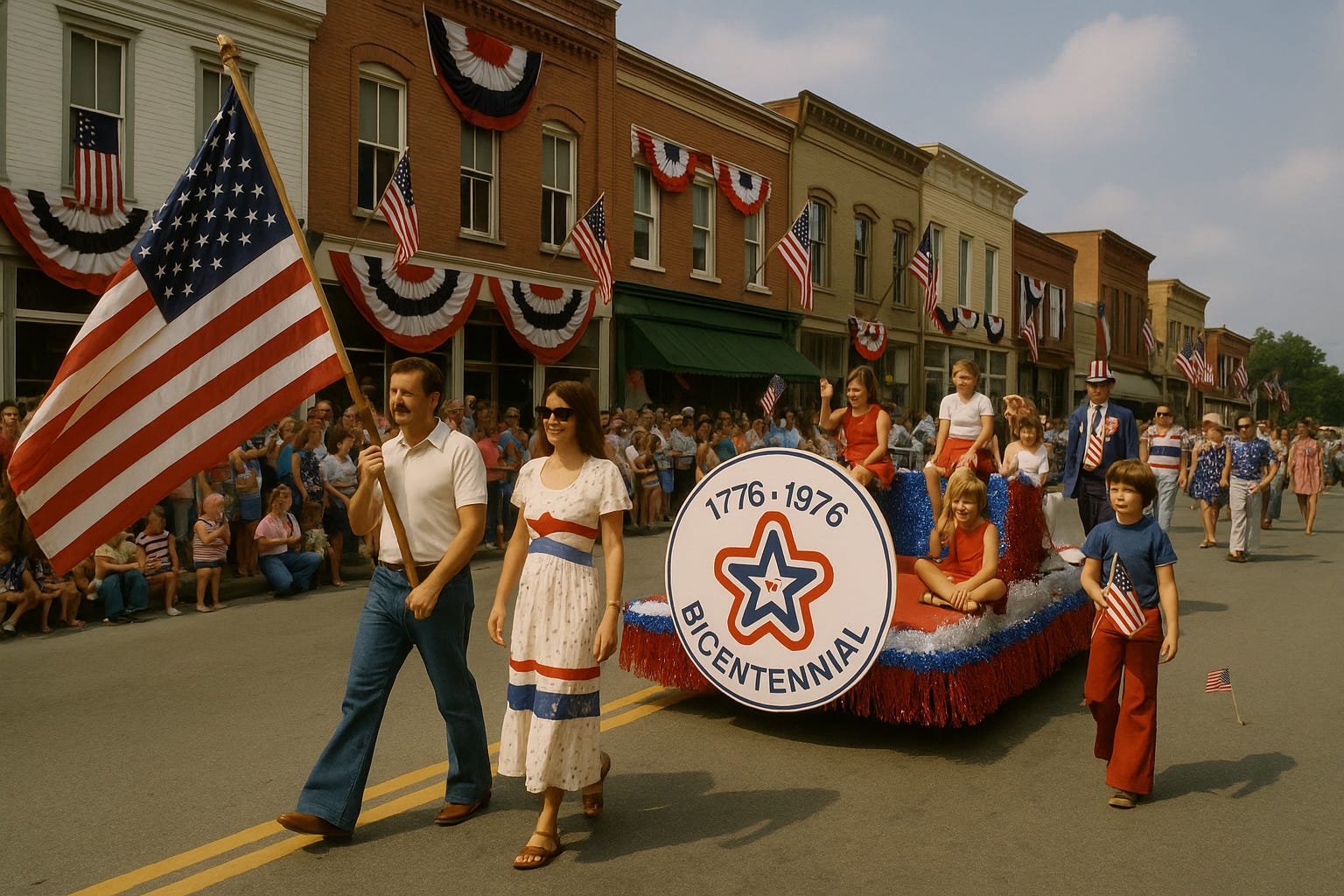
For me, that summer also held a trip to St. Louis to see the Cardinals play, and the Olympics were starting in Montreal in a couple of weeks. After that, I would be off to college, hoping to embark on dreams I didn’t even know existed yet.
When the Bicentennial fireworks lit up the sky, America felt like a place still capable of starting over. We had just come through an unthinkable atrocity of a war, political scandal (Watergate was behind us), and division, but there was this wide-eyed belief—especially among the young—that the country could still live up to its promises if enough of us cared to try. Neighborhoods threw block parties where nobody talked much about politics, just the fact that we’d made it 200 years and were still standing. Maybe that spirit feels naïve now, but it was real—that hunch that no matter how many times we fall short, there’s always another chance to build something truer, kinder, more just.
In 1976, it felt as though America was finally embarking on its true mission—to make real the promise that all people are created equal. After centuries of exclusion and injustice, horrifying racism and numerous other social injustices, there was a sense—fragile but genuine—that the country was, at last, willing to look itself in the mirror and begin the work of becoming whole.
Does that spirit still wait for us today? I hope so.
I’ve had good Fourth of Julys since then—lighting fireworks with my kids, sitting on picnic blankets watching the sky crack open with color. I’ve had years when the holiday felt solemn, even grim, and other years when it felt like a break from everything else. There have been years when we were on vacation. And I’ve watched a lot of baseball games. But nothing has ever quite topped 1976. That year was different.
I’d like to know where the country is going—I think we all would. These days, it doesn’t feel like anyplace good—and that’s an understatement. More than anything, I’d like to have feeling I had in 1976—standing under a sky full of fireworks, believing for once that we might get it right. And this time, I’d like the feeling to be real.