It’s April. Baseball is back — the real kind, not the February mirage. The ball sounds different again. The air carries. You can feel it when a fastball snaps into leather, when a hitter turns on one and you know before the crowd does.
I want to write about that.
I want to write about spring — the way it shows up whether we deserve it or not. The way it softens everything for a minute. The way people fall in love again, or at least convince themselves they have.
I want to write about the Final Fours — except now they’re over. Nets cut, confetti swept, another set of champions crowned, another set of kids who were supposed to just be part of the machine instead became the moment. For a couple nights, it still felt like the game mattered more than the money.
I want to write about baseball.But I keep coming back to nothing.
And then I keep coming back to him.
The Noise That Won’t Shut Off
Every time I try to think clean — really think — I run into the same wall: Donald Trump. Not just politics. Not the scoreboard version of it where we keep track like it’s wins and losses. Something heavier. Something that sticks.
The kind of thing that doesn’t let you stay in baseball for very long.
War, Announced Like a Promotion
Because now it’s not just noise. It’s war talk. Not buried. Not filtered. Not carefully delivered like presidents used to do when they at least pretended the weight of it mattered.
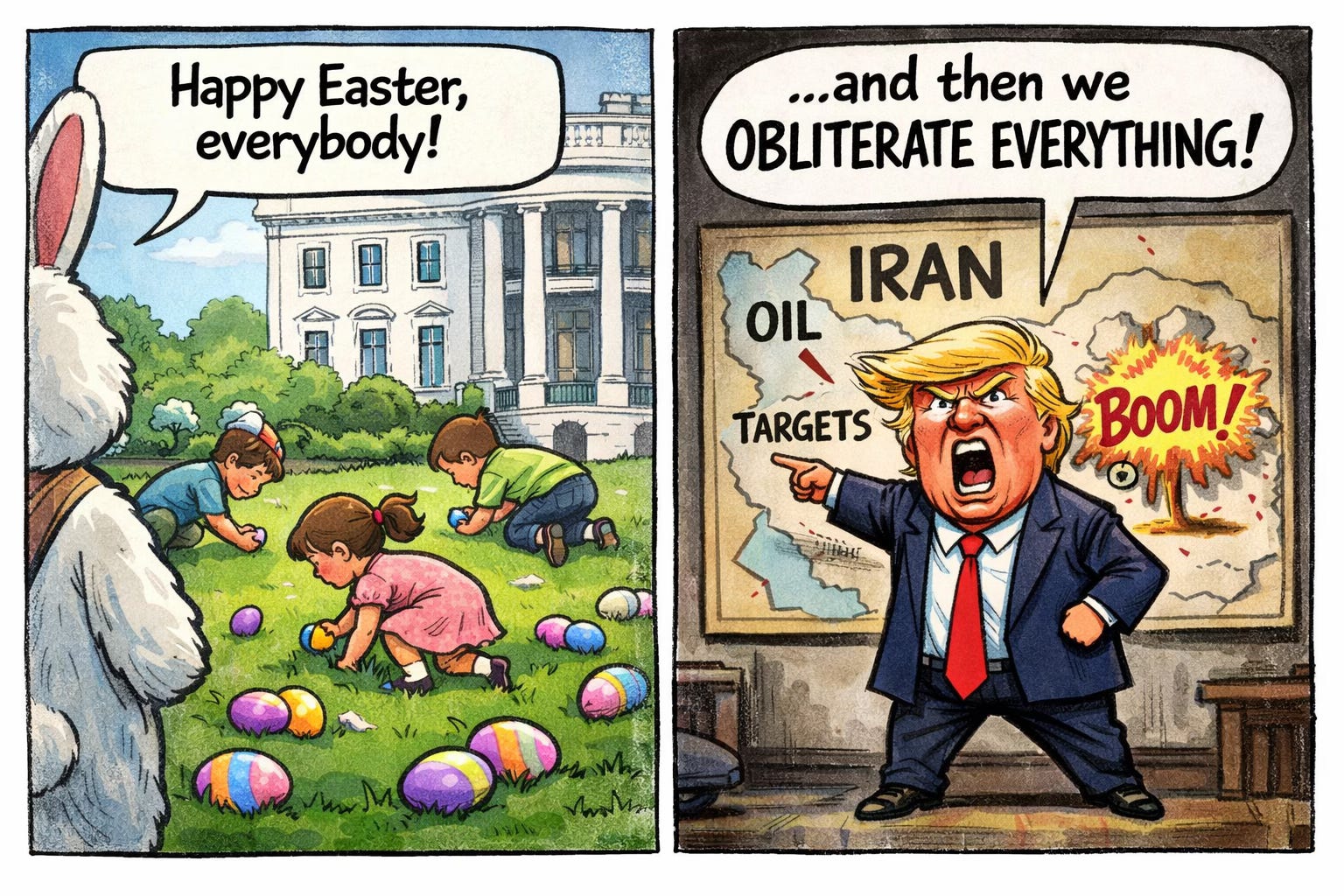
This is loud. Casual. Marketed. Threats toward Iran — open, public, repeated. Talk of destroying infrastructure. Power grids. Bridges. The bones of a country. Language like obliteration. And it’s not just the words. It’s the setting.
An Easter event.
Kids running across the lawn chasing eggs. Bright colors. Laughter. Plastic baskets. And off to the side — or sometimes not even off to the side — the President of the United States talking about war. Talking about what could be destroyed. Talking about what might be next.
There was a speech — part rally, part ramble, part warning — delivered with all the weight of a man ordering lunch. You couldn’t script that if you tried.
You wouldn’t. Because it would feel too on-the-nose. Too absurd.
“Obliteration” Starts to Sound Normal
That’s the part that gets in your head. Not just what’s being said. But how quickly it starts to feel like background noise.
“Obliterate.”
“Demolish.”
“End them.”
Words that should stop everything. Instead, they slide right into the feed. Right next to box scores. Right next to highlight clips. Right next to a kid cutting down a net.
There’s even this pause — this “two-week window” language — like war has a schedule. Like it’s a series you can push back because the weather turned or the ratings weren’t right. And the world reacts, but only halfway.
Markets twitch. Analysts talk. Military guys go on TV and warn about escalation, about oil, about bases, about what happens if the Strait of Hormuz closes completely.
And then we flip back to baseball.
The Stallard Blurb is reader-supported. To receive new posts and support my work, consider becoming a free or paid subscriber.
A Ritual to Read to Each Other
by William E. Stafford
If you don’t know the kind of person I am and I don’t know the kind of person you are a pattern that others made may prevail in the world and following the wrong god home we may miss our star.
For there is many a small betrayal in the mind, a shrug that lets the fragile sequence break sending with shouts the horrible errors of childhood storming out to play through the broken dike.
And as elephants parade holding each elephant’s tail, but if one wanders the circus won’t find the park, I call it cruel and maybe the root of all cruelty to know what occurs but not recognize the fact.
And so I appeal to a voice, to something shadowy, a remote important region in all who talk: though we could fool each other, we should consider— lest the parade of our mutual life get lost in the dark.
For it is important that awake people be awake, or a breaking line may discourage them back to sleep; the signals we give — yes or no, or maybe — should be clear: the darkness around us is deep.
I was fortunate to meet William Stafford at the Midnight SunWriter’s Conference at the University of Alaska - Fairbanks in the summer of 1979. You can read more about that summer and my time there in this post.
Meanwhile, Back at the Ballpark
You try. You really do. You sit down and think:
Write about the Royals bullpen.
Write about Cole Ragans finding something.
Write about April baseball — the kind that still belongs to possibility.
But your brain doesn’t stay there. It does this instead:
If the Strait of Hormuz stays shuts down, oil continues to spikes.
If oil continues to spike, everything shifts.
If everything shifts, this isn’t just “over there.”
And then something else slips in:
Civilians in Iran forming human chains around infrastructure.
Standing in front of power plants.
Trying to make themselves the target so the bombs don’t hit.
And now you’re supposed to pivot back to a 2–1 game in the sixth?
Thanks for reading! This post is public so feel free to share it.
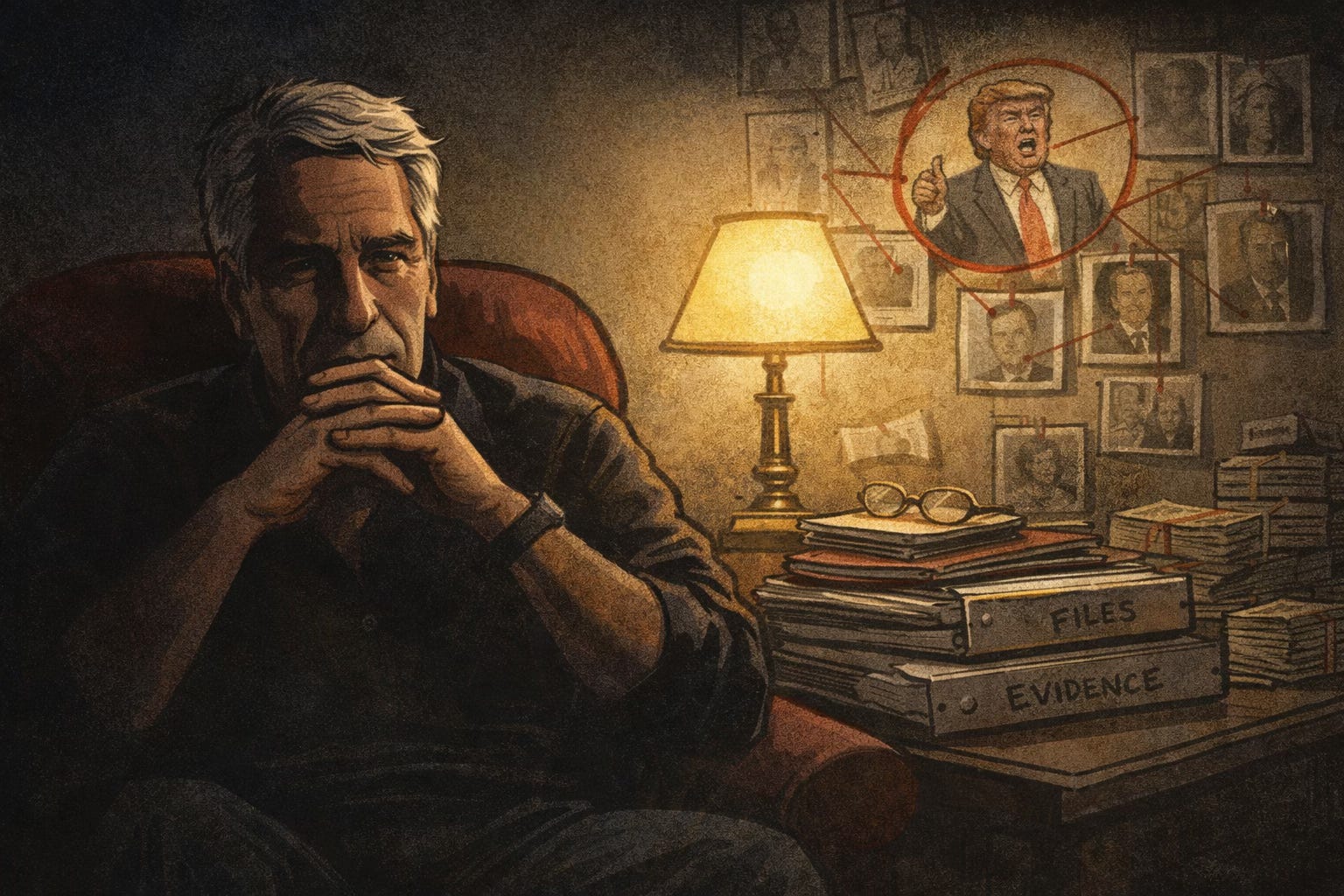
And then — because the mind doesn’t move in straight lines — you circle back again. To Jeffrey Epstein. Because that never got finished either. And somehow, it sits in the same space. Power. Access. Protection. Silence. Trump is part of that orbit. That’s real:
Social ties in the 1990s and early 2000s
Public comments about Epstein’s behavior
Photos, proximity, overlap
Trump later distanced himself, said they had a falling out, banned him from Mar-a-Lago. There were also allegations — filed, then withdrawn — that tied him more directly to Epstein’s abuse network. Those claims were never proven in court.
So you’re left with this:
Not a clean story.
Not a closed case.
Not a full accounting.
Just fragments.
Enough to feel it.
Not enough to resolve it. Not enough Republicans to ensure the release of the Epstein files.
Nothing was ever fully explained, or released. That’s the problem. AI GEN
Why You Can’t Just Write About Baseball
Because once you see all of that—once you understand that:
War can be floated casually
Power can speak in threats and still be normalized
A massive criminal network can exist in plain sight and still feel unresolved
You don’t get to go back to simple. You don’t get to just write:
“The ball carries better in April.”
I try. But my brain keeps asking:
Who’s really in control?
What gets covered up?
What gets forgotten?
What are we pretending not to see?
And then it loops.
Back to Trump. Back to Iran. Back to Epstein. Back to the same unfinished edges.
Back to TRUMP.
Who Are We?
Who are we, exactly? Because this is what we’ve watched — again — since Donald Trump took office last year:
We’ve seen federal pressure on education — curriculum fights, funding threats, and a steady push to decide what can and cannot be taught. Not just debates over standards, but battles over memory itself.
Black leaders minimized. Women leaders sidelined. Whole chapters softened, shortened, or stripped of their sharp edges so they fit a cleaner, safer version of the past. History, rewritten not always by what’s added — but by what quietly disappears.
We’ve watched Diversity, Equity, and Inclusion (DEI) programs get dismantled — labeled as excess, as ideology, as something to be removed rather than improved. Not a conversation. A purge.
We’ve seen public institutions — libraries, universities, even NPR — pulled into political crossfire. Funding threatened. Credibility questioned. The idea of shared truth chipped away piece by piece.
We’ve heard language — again and again — that turns disagreement into enemies. That simplifies complex problems into slogans. That trades understanding for outrage because outrage travels faster.
And maybe the hardest part to sit with — we’ve watched large parts of the country — especially rural America — lean into it.
Not because they’re stupid. Not because they’re evil. Because they’re tired.
Because factories closed. Towns shrank. Schools lost funding. Hospitals disappeared. Because they felt like nobody was talking to them anymore.
And then someone did.
Even if the message was incomplete. Even if it pointed blame more than it offered answers. Even if it told them what they wanted to hear instead of what they needed to know.
That’s the fracture. Not just policy. Not just politics.
Identity.
Memory.
Truth.
So again — who are we?
Because if we can erase parts of our story this easily… if we can turn on each other this quickly… if we can accept noise over truth this willingly — then maybe the question isn’t what’s happening.
It’s why it feels so familiar.
Spring Still Shows Up Anyway
And here’s the strange part. The part that almost saves it. Spring doesn’t care.
It doesn’t wait for clarity.
It doesn’t wait for truth.
It doesn’t wait for us to figure out what the hell is going on.
It just shows up. Grass grows in Kansas City. A kid takes batting practice until his hands sting. Somewhere, someone nobody believed in is hitting .340 and doesn’t know yet that this is the year his life changes. The Final Fours ended, and for a few nights, it still meant something pure.
Not perfect. But real. Some kids cut down nets and believed it mattered.
And maybe it did.
But You Don’t Get to Ignore It
That’s the tension. That’s the whole thing. You don’t want to write about Trump. You don’t want to write about Iran. You definitely don’t want to write about Epstein.
But they sit there anyway.
Like a pitch just off the plate you don’t swing at — and still think about three innings later.
Nothing… and Everything
So yeah. I’ve got nothing.
No clean angle. No tidy lead. No way to separate the beauty of a baseball game from the weight sitting just behind it. Just this:
The games are starting.
The weather’s turning.
Life is trying — stubbornly — to move forward.
And in the background:
War gets talked about like a scheduling decision. “Obliteration” becomes just another word. Kids hunt Easter eggs while adults talk about destroying countries. And old ghosts — Epstein, power, silence — never quite leave the field.
The Ceasefire That Isn’t
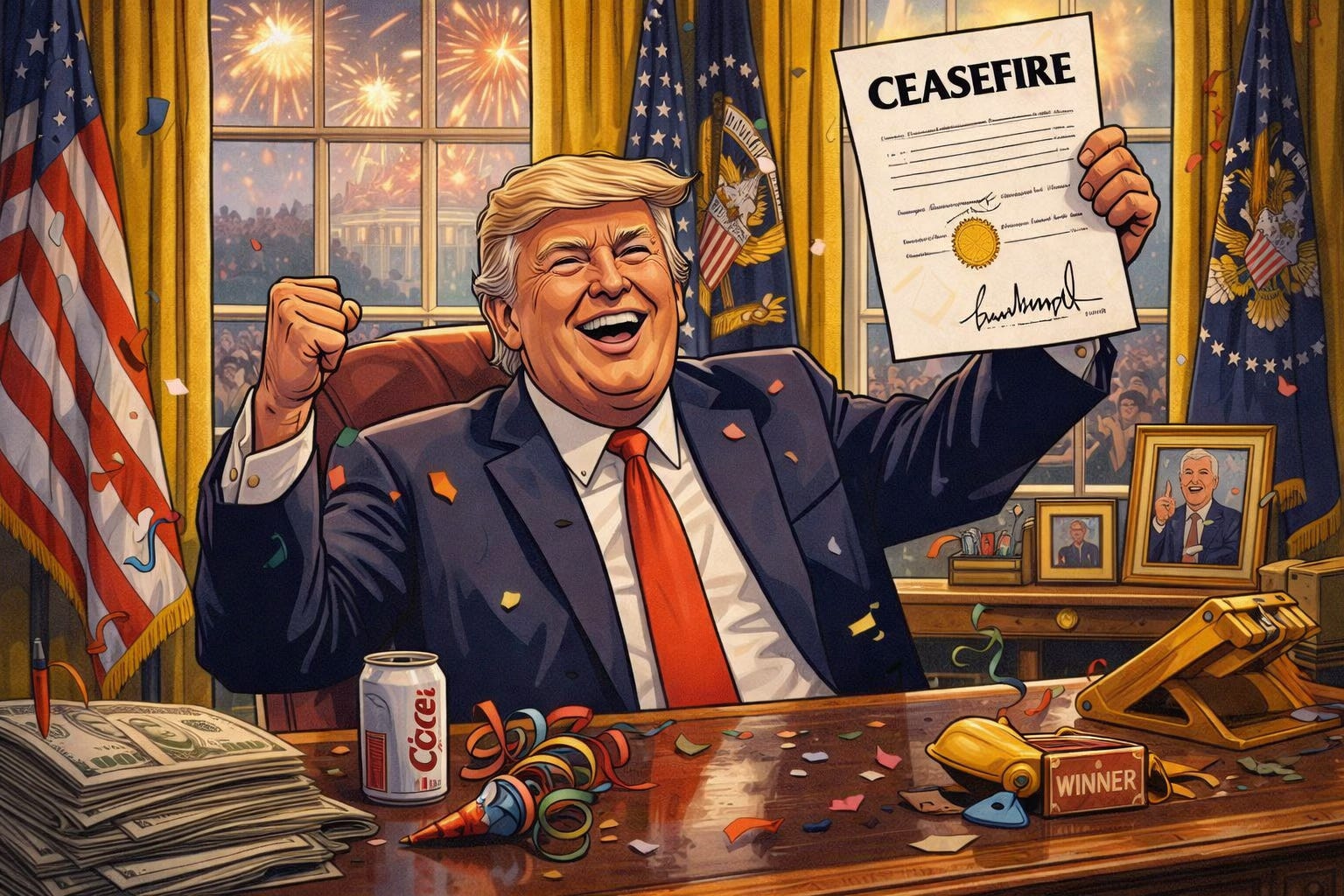
And then there’s the ceasefire. Or what they’re calling a ceasefire. A pause. A window. A delay. Two weeks. Maybe less. Maybe more. Depends on who’s talking, when they’re talking, and what they need it to sound like in that moment.
It gets announced like progress. It gets framed like restraint. It gets sold like control. So you look for the details.
What did we agree to? What did they agree to? What are the terms? And that’s when it hits you — there isn’t much there.
No clear list. No defined commitments. No structure you can point to and say, that’s the deal.
Just broad language. A pause in escalation. Conditions that shift depending on who’s explaining them. Negotiations that may or may not be happening somewhere you can’t see. It feels like something that should be solid. But it isn’t.
It’s soft.
It’s vague.
It’s temporary by design.
Not peace.
Not resolution.
Not even clarity.
Just… space.
Space filled with the same threats. The same language. The same countdown sitting just beneath the surface. A ceasefire that isn’t an ending — just a breath between sentences.
And maybe that’s what gets to you. Because even the things that are supposed to mean something…
ceasefire
agreement
diplomacy
... they don’t land the same anymore. They feel temporary. Conditional. Fragile.
Like everything else. Like truth. Like accountability. Like whatever it is we’re all pretending still holds. So you try to take it for what it is.
A pause. A chance. A moment where nothing happens. But even that — even nothing— doesn’t feel real anymore.
Closing With Nothing
We wait for the crack of the bat, the warmth of the sun, the feeling that things make sense again. And then we remember…
… they never really did.
The Stallard Blurb is reader-supported. To receive new posts and support my work, consider becoming a free or paid subscriber.